

With the widespread application of antibiotics, the global situation of bacterial resistance is becoming increasingly severe. Since the 1980s, only a few new antibiotics have been developed. From 1996 to 2000, there were only six new antibiotics on the global market, and since the beginning of the 21st century, this field has been almost blank. It seems that humanity will soon enter the "post antibiotic era" without available antibiotics. As a result, the value of bacteriophages has been re examined and evaluated. This article mainly reviews the application and prospects of bacteriophage technology in feed after antibiotic prohibition.
The application of bacteriophage technology in feed after antibiotic prohibition
Summary
Bacteriophages are essentially viruses that can infect bacteria, widely distributed in nature, and have a bactericidal effect on target bacteria that can be infected. They can replace antibiotics for disease treatment in clinical practice. With the introduction of anti antibiotic policies in China's feed industry, non antibiotic aquaculture has become a trend for future development. In this context, bacteriophage technology has received widespread attention from the industry and has been applied in fields such as animal husbandry, environmental protection, and disease treatment. Compared with antibiotics, bacteriophages have the advantages of high safety, more thorough treatment, and no drug residues. With the progress of science and continuous improvement of technology, bacteriophage technology will be increasingly widely used in the field of aquaculture.
Introduction
Bacteriophage technology is one of the important technologies that can replace antibiotics in the field of aquaculture. It has been studied and promoted in the livestock industry, mainly used to control infections such as Escherichia coli, Salmonella, and Clostridium Wei in poultry and livestock. This technology is currently widely used in non antibiotic aquaculture.
1、 Background of feed antibiotic prohibition
With the development of society and the continuous improvement of economic level, people's consumption of animal protein has also shown a trend of increasing year by year, directly promoting the development of intensive and large-scale animal husbandry. However, excessive concentration of animal husbandry will inevitably lead to the occurrence of diseases, especially infectious diseases. In large-scale breeding farms, once one animal is infected, it can quickly spread to the entire population, causing significant economic losses. In order to control the occurrence of diseases and promote better animal growth, China allowed a portion of antibiotics to be added to feed in the early stage. These antibiotics can greatly inhibit the reproduction of pathogens ingested in the environment and conditionally existing pathogens in the intestine, greatly reducing the risk of diseases. At the same time, they also accelerate the growth and development of animals to a certain extent, greatly improving production performance, Furthermore, it maximizes the economic benefits of the breeding farm. But with the increasing attention paid to food safety, the issue of antibiotic residues in veterinary drugs has been put on the agenda in recent years. China has also begun to forcibly prohibit the addition of related antibiotics in feed since 2020.

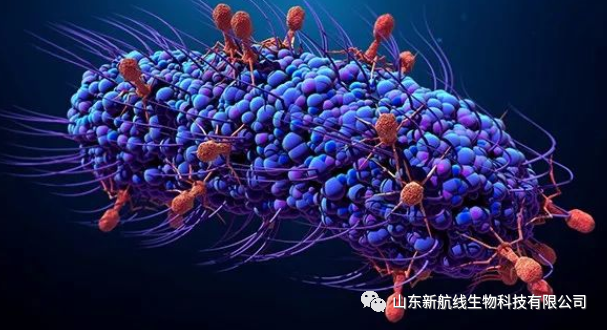
图1 噬菌体在家禽养殖业中的应用实例
2、 Introduction to bacteriophages
A bacteriophage is a virus that has an invasive effect on bacteria, and its individual is small and does not have a complete cellular structure. Bacteriophages themselves cannot complete independent metabolism and can only proliferate when parasitized in hosts such as bacteria. Once they leave the host cell, bacteriophages cannot grow or replicate. Bacteriophages are widely distributed in nature and can be found in places filled with bacterial communities, such as soil, air, forests, sewage ditches, rivers, lakes, animal surfaces, and intestinal contents. Most bacteriophages are tadpole shaped, while a small portion are microsphere and slender rod shaped. In addition to bacteria, some bacteriophages also have infectivity against actinomycetes, spirochetes, and algae. From the analysis of structural composition, bacteriophages are composed of surface protein shells and core nucleic acid components. There is only one type of nucleic acid, either DNA or RNA, double stranded or single stranded, circular or linear. Under an electron microscope, bacteriophages are divided into three parts: the head, neck, and tail. The head is the site where nucleic acids exist, and the neck and tail are used to identify and infect bacteria. At the same time, the nucleic acid components from the head are injected into the bacterial body, completing replication within the bacteria and obtaining a large number of offspring bacteriophages.
3、 Bacteriophage infection process
When bacteriophages infect bacteria, they have their own steps. First, they recognize the host cell through the tail filament protein. If the information matches, the bacteriophage will attach its tail filament to the surface of the host bacteria. Then, it will dissolve the membrane protein and phospholipid molecular layer, creating a "hole" on the surface of the host bacteria. The bacteriophage then injects its nucleic acid into the cytoplasm of the bacteria through the "hole", using the organelles, nucleotides Synthases and other enzymes replicate nucleic acids, while obtaining messenger RNA through transcription or reverse transcription. The ribose in the host bacteria uses messenger RNA as a template to synthesize and translate the outer shell protein of bacteriophages, obtaining a large amount of protein shells. The replicated nucleic acid and a large number of protein shells are reassembled in a one-to-one manner to obtain new progeny bacteriophages. The progeny bacteriophages can obtain thousands of them at once within a host cell, and a large number of bacteriophages break down the host bacteria, which is the process of killing bacteria. After the host bacteria lyse, the progeny bacteriophages will be released and search for the next bacterial target for infection, continuing to repeat the above process.
4、 Application
At present, bacteriophage technology is mainly applied in fields such as animal husbandry, environmental protection, agriculture, and disease treatment. In the field of animal husbandry, it is mainly used for the prevention and treatment of Escherichia coli and Salmonella infections, such as yellow and white dysentery in piglets, white dysentery in chicks, pig typhoid fever, paratyphoid fever, and the treatment of perihepatitis, pericarditis, pneumocystitis, salpingitis, and enteritis caused by Escherichia coli infections in adult chickens. Compared with antibiotics, bacteriophages have the advantages of strong specificity, less susceptibility to drug resistance, safer use, and more thorough treatment. In terms of environmental protection, bacteriophages can degrade harmful bacteria in the environment, preventing them from producing harmful gases such as hydrogen sulfide and ammonia to pollute the environment. They have a good effect on treating livestock manure pollution. In agriculture, bacteriophages can be used to control crop yield decline caused by infection with pathogenic bacteria. In the field of human disease treatment, bacteriophages can be used to treat sepsis caused by multidrug-resistant bacterial infections. disclaimers
The above images and some of the content of the paper materials are sourced from the internet, and the copyright belongs to the original author; The purpose of publishing this article is to disseminate market information more widely, and the content of the article is for reference only. If the content of this gallery or article infringes on your rights, please contact us to delete it.

Address: 31-3-102, Jinke Smart Technology City, 200m in the south of the intersection between Changsong Road and Chunyuan Road, Weicheng District, Weifang City, Shandong Province
Contact person: Manager Cao
Tel.: 86 0536-2201616
Website: www.xhx-best.com
