
Preface
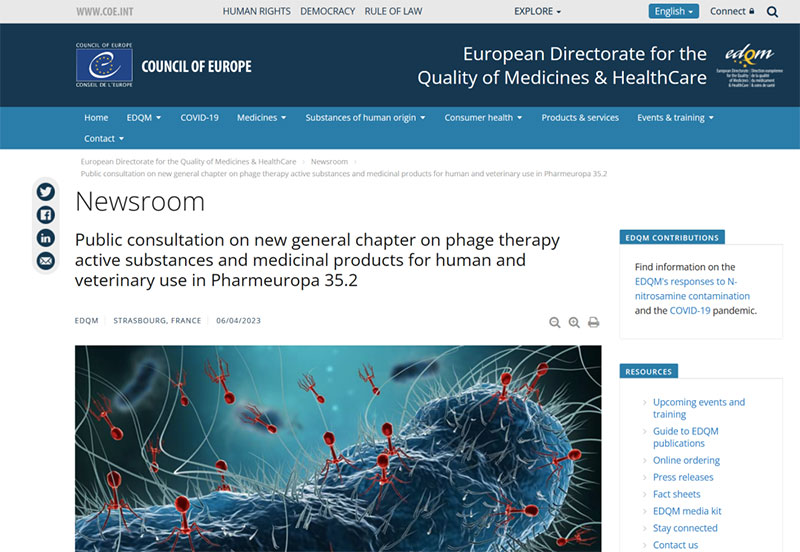
In June 2021, the European Pharmacopoeia Commission (EPC) agreed at its 170th session to develop a new general chapter on human and veterinary bacteriophage therapy active substances and drugs (5.31), and to assign this task to the newly established bacteriophage working group (BACT WP). The draft of this chapter has been drafted and is now open for public consultation in Europe (as of the end of June). This is the inclusion of bacteriophage therapy active substances/drugs in the pharmacopoeia. This article is a Chinese translation of this general rule.
1-1. Definition
Bacteriophages are viruses that infect bacteria and rely on their bacterial hosts for replication. Bacteriophages are composed of a genome composed of single or double stranded DNA or RNA and an outer protein capsid. Phage therapy pharmaceutical products are preparations of naturally occurring or genetically modified bacteriophages used to treat bacterial infections or other medical conditions in humans or animals. PTMP can contain a bacteriophage therapeutic active substance, or a mixture of bacteriophages, or combine with excipients. PTMPs can be administered through multiple pathways and can be assigned to different dosage forms.
1-2. Production
Phages are obtained by multiplying in bacterial host strains and purified using appropriate methods. The production process needs to produce consistent quality and stable PTMP. Implement appropriate in-process testing at relevant time points and/or critical intermediate stages in the production process. The production of PTMPs is based on a qualified seed batch system that utilizes a validated host phage combination.
2-1. General provisions
Phages are obtained by multiplying in bacterial host strains and purified using appropriate methods.
The production process needs to produce consistent quality and stable PTMP. Implement appropriate in-process testing at relevant time points and/or critical intermediate stages in the production process.
The production of PTMPs is based on a qualified seed batch system that utilizes a validated host phage combination.
2-2. Bacterial main cell bank and working cell bank
The bacterial host cells used for PTMP production must be characterized in detail at the strain level, including the source of the strain, subsequent operations, and testing for strain characterization.
The bacterial cells used for PTMP production must be sourced from a qualified bacterial main cell bank, must be monoclonal, and meet the following requirements:
Microbial purity: Determine the presence of microbial pollutants through planking or other appropriate methods.
Identification: The bacterial strain is characterized through appropriate phenotype and genotype methods, with preferred whole genome sequencing, biochemical or molecular genetic testing, or mass spectrometry analysis. This typing must include the antibiotic sensitivity profile and the nucleotide sequences of its chromosomes and plasmids. Avoid using strains of coding contamination sources (such as bacteriophages) or other harmful factors (such as antibiotic resistance determinants, toxins) in PTMP production, unless otherwise justified and authorized.
Cell viability: The number of live cells is determined by plate counting or other appropriate live cell counting methods.
Bacteriophage sensitivity: The sensitivity of a strain to bacteriophage therapeutic active substances is demonstrated by plaque assay or other appropriate methods.
No unfavorable bacteriophages: It is confirmed that there are no bacteriophages (such as lysogenic bacteriophages) that may be unfavorable to PTMPs.
The working cell bank used for production is a clone derivative of the main cell bank, which meets the requirements of vitality, microbial purity, and phage sensitivity.
2-3. Phages used for producing PTMPs
The bacteriophages used in PTMP production must be characterized in detail. Please provide information on the source of bacteriophages, nucleotide sequences, and susceptible bacterial species. Avoid using bacteriophages encoding known or potentially harmful genetic factors, such as antibiotic resistance determinants, toxins, lysogenic modules, or other elements, unless otherwise justified and authorized.
Only main phage libraries that meet the following requirements can be used for production:
Identification: Bacteriophages are identified through appropriate phenotypic and genotypic methods, including plaque morphology and whole genome sequencing. For genetically or chemically modified bacteriophages, the modification and its effects must be described and identified in detail.
Phage Purity: Phages are purified through repeated plaque purification until a homogeneous plaque morphology of phage lysate is obtained, which contains a clone of a phage strain.
Potency: The titer of infectious bacteriophages is determined by plaque assay or other appropriate methods.
Sterility (2.6.1): Must comply with sterility testing.
The working phage library used for production is a clone derivative of the main phage library, which must meet the requirements of phage purity, sterility, and potency.
2-4. Production and purification
The production of PTMPs is based on a seed batch system, and cross contamination between different phages and bacterial host strains needs to be strictly avoided.
Using medicinal grade raw materials. Biomaterials also need to comply with the requirements of General Rule 5.2.12 (Biomaterials used for the production of cell gene therapy drugs).
Bacteriophages are purified using appropriate techniques.
Several single harvest products of the same phage clone may merge before the purification process.
Only purified harvested products that meet the following requirements can be used to prepare finished batches:
Identification: Use relevant genotype and phenotype markers to confirm each bacteriophage.
Potency: The titer of infectious bacteriophages is determined by plaque assay or other appropriate methods.
Microbiological examination (2.6.12): Meets established standards.
Residual reagents: Based on risk analysis, test the residual reagents and safety risks used in the production process of purified harvested products.
Host cell impurities and pollutants: Pollutants and other potentially toxic substances (such as endotoxins and exotoxins, host cell proteins, host cell DNA) from host cells do not exist or are within the approved limits of specific formulations.
2-5. Finished product batch
The finished batch can be formulated into several different dosage forms: solid (such as tablets), liquid (such as injection or oral), or lyophilized formulations.
The finished batch meets the following requirements:
Appearance: Meets established specifications.
Identification: Use relevant genotype and phenotype markers to confirm the identity of bacteriophages.
Potency: The infectious potency of each bacteriophage, expressed in PFU/mL or PFU/mg, determined by plaque assay or other appropriate methods, and within the approved range of a specific formulation.
Sterility (2.6.1): For sterile PTMPs, they meet the sterility test.
Microbiological quality: For non sterile PTMPs, Chapter 5.1.4 (Microbiological quality of non sterile pharmaceutical preparations and substances) provides recommendations.
Thermogenicity [1] (5.1.13): Specific formulations, if applicable, should comply with appropriate pyrogenicity testing.
Freeze dried PTMPs also need to meet the following additional requirements:
Moisture content (2.5.12 or 2.5.32): Meets specific product approval limits.
Liquid PTMPs also need to meet the following additional requirements:
PH (2.2.3): Meets specific product approval restrictions.
2-6. Adaptive products
Phage adaptation refers to the process in which PTMP can evolve in a targeted manner to increase its efficacy in clinical isolation of bacterial strains from individual patients. The individual bacteriophages or combinations of bacteriophages used for bacteriophage adaptation comply with the provisions of sections 2-3. The potency of adaptive PTMP in finished product batches was detected using target clinical isolates. The finished batch complies with the provisions of Section 2-5 on appearance, sterility (or microbial contamination), and pyrogenicity, unless otherwise justified and authorized.
3-1. Labels
Applicable labeling requirements outlined in relevant supranational and national regulations.
[1] Pharmacopoeia 35.1 includes a new general rule - Pyrogenicity (5.1.13), which provides guidance on the selection of pyrogen detection methods.

Address: 31-3-102, Jinke Smart Technology City, 200m in the south of the intersection between Changsong Road and Chunyuan Road, Weicheng District, Weifang City, Shandong Province
Contact person: Manager Cao
Tel.: 86 0536-2201616
Website: www.xhx-best.com
